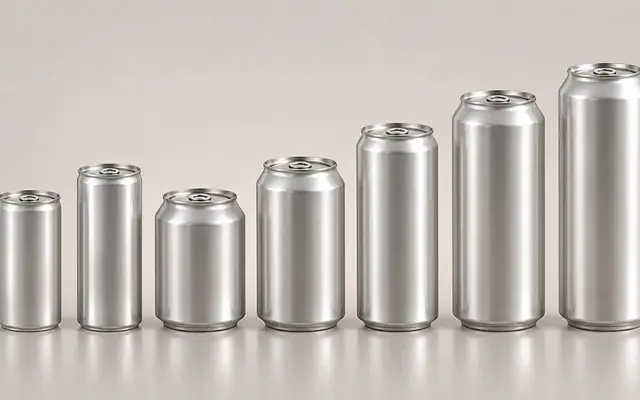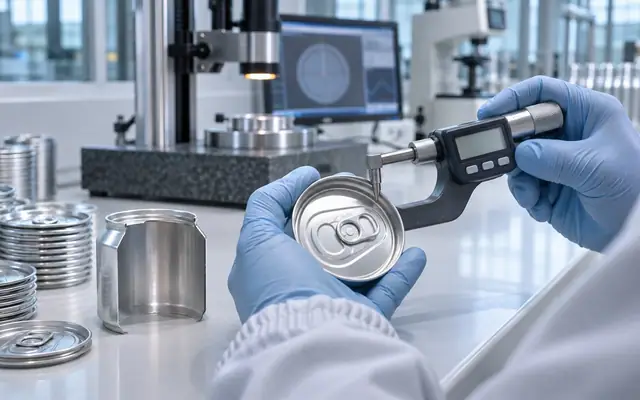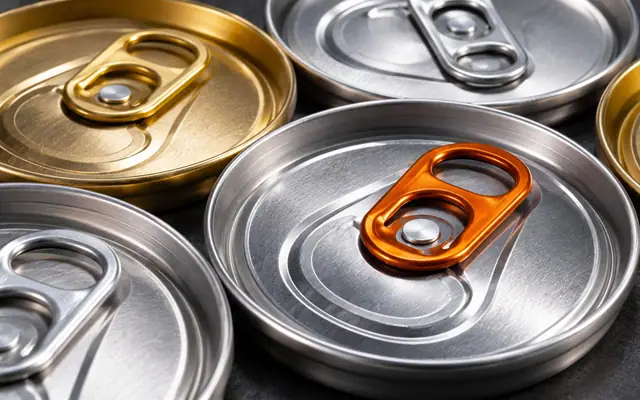
SOT (stay-on-tab) ends are the standard opening for beer and soft drinks; RPT ends are a ring-pull style used mainly on slim cans; 360 full-aperture ends remove the whole panel so the can becomes a cup; peel-off ends use a foil membrane for powders and dry food.
Why the end matters as much as the can
The end is the most engineered part of a beverage can. It has to hold internal pressure, seal hermetically on the seamer, open with a reasonable force and leave a safe opening. It is also the part of the package the consumer touches first — a coloured tab or full-aperture opening is a strong brand signal.
SOT — stay-on-tab ends
Stay-on-tab ends are what most people picture: the tab levers a scored panel into the can and stays attached. They are the default for beer, carbonated soft drinks, juice and water.
- Sizes: 200, 202, 206, 209 (202 is most common)
- Profiles: B64 and CDL — CDL uses less aluminum but needs matching seamer chucks
- Branding: coloured tabs, laser marking, embossed tabs
RPT ends
RPT ends are widely used on 200 neck slim cans in Asia for energy drinks and teas. They open in a similar way to SOT ends and are often specified with a coloured tab. Confirm with your seamer supplier that your chuck and rolls suit the end profile.
360 full-aperture ends
A full-aperture end removes the whole centre panel, leaving a smooth rim so the can can be used like a cup. It gives drinkers the aroma and pour of a glass, which is why it is popular for craft beer, cocktails and stadium service. See 360 full-aperture ends.
Peel-off ends
Peel-off ends (POE) use a foil membrane heat-sealed to a metal ring. They are used for milk powder, coffee, nuts, snacks and pet food in aluminum, tinplate, composite and PET cans — any product that does not need to hold carbonation pressure. See peel-off ends.
Comparison table
| End type | Best for | Holds carbonation | Opening |
|---|---|---|---|
| SOT | Beer, CSD, juice, water | Yes | Drinking hole |
| RPT | Slim-can energy drinks, tea | Yes | Drinking hole |
| 360 full aperture | Craft beer, cocktails, venues | Yes | Entire top |
| Peel-off | Powders, nuts, dry food | No | Entire top |
What to send your supplier
- Can diameter and neck (for example 211 body / 202 neck)
- Seamer make and model, and chuck profile (B64 or CDL)
- Product type and carbonation level (CO₂ volumes)
- Any pasteurisation or retort conditions
- Tab and end colour preferences
With this information we can supply a dimensionally matched end and seaming specifications. Ask for samples.
Frequently asked questions
Which can end is best for beer?
Most beer is packed with 202 SOT ends. Craft brewers who want a glass-like drinking experience use 360 full-aperture ends.
Can peel-off ends be used for carbonated drinks?
No. Peel-off ends are designed for dry and non-carbonated products; carbonated beverages need SOT, RPT or full-aperture beverage ends.